Youth racing: why cadence is king
By Andrew Layhe • 3 June 2026
7 min read
Youth racing isn’t just about who’s strongest. Quite often, it’s about who can turn the gear properly when the race gets fast.I’ve seen this loads over the years. A young rider looks comfortable while the pace is steady, sitting nicely in the bunch, moving well, doing nothing obviously wrong. Then the speed lifts, the restricted gear starts to run out, and suddenly the whole picture changes. The legs start spinning faster, the shoulders tighten, the hips start bouncing, the hands grip the bars a bit too hard, and the wheel in front begins to drift away.That doesn’t always mean the rider isn’t fit enough. It doesn’t always mean they lack effort either. Sometimes they’ve simply run out of cadence skill.That’s why cadence matters so much in youth racing. But this isn’t only about spinning quickly. It’s about development, race intelligence, efficiency, control and building riders properly from the start.TL;DR
Youth gearing doesn’t just restrict young riders, it teaches them. When the race gets fast, restricted gears expose whether a rider can pedal smoothly at high cadence without bouncing, tensing up or wasting energy.Parents and riders shouldn’t see cadence as something to survive until junior racing. The ability to spin well carries through a rider’s whole career, helping with acceleration, bunch riding, late-race fatigue and long-term durability.The goal isn’t just faster legs. It’s better riders.Restricted gears reveal skill
Youth gearing rules are often seen as a limitation. Riders can find them frustrating, parents can see them as something their child has to get through, and everyone looks forward to the day when bigger gears become available. That’s understandable, but it misses a valuable point.Restricted gearing forces riders to learn something that many older riders only discover much later: speed doesn’t come from strength alone. It comes from coordination, rhythm, timing and the ability to keep the bike moving efficiently when the race changes shape.At low speeds, most riders can look tidy enough. The cadence is comfortable, the bunch is settled and nobody is under too much pressure. But when the pace rises to 30 mph and above, the same gear suddenly demands a much higher cadence. That’s when the differences appear.One rider stays smooth. The legs move quickly, but the body remains quiet. The bike continues to roll forward cleanly. Another rider starts bouncing in the saddle, rocking through the hips and fighting the bike like it owes them money. They may still be strong, but the effort has become messy.And messy is expensive.Once the upper body tightens and the rider loses rhythm, energy starts leaking everywhere. That’s why a young rider doesn’t just need a good engine. They need to learn how to use that engine cleanly.What the numbers show
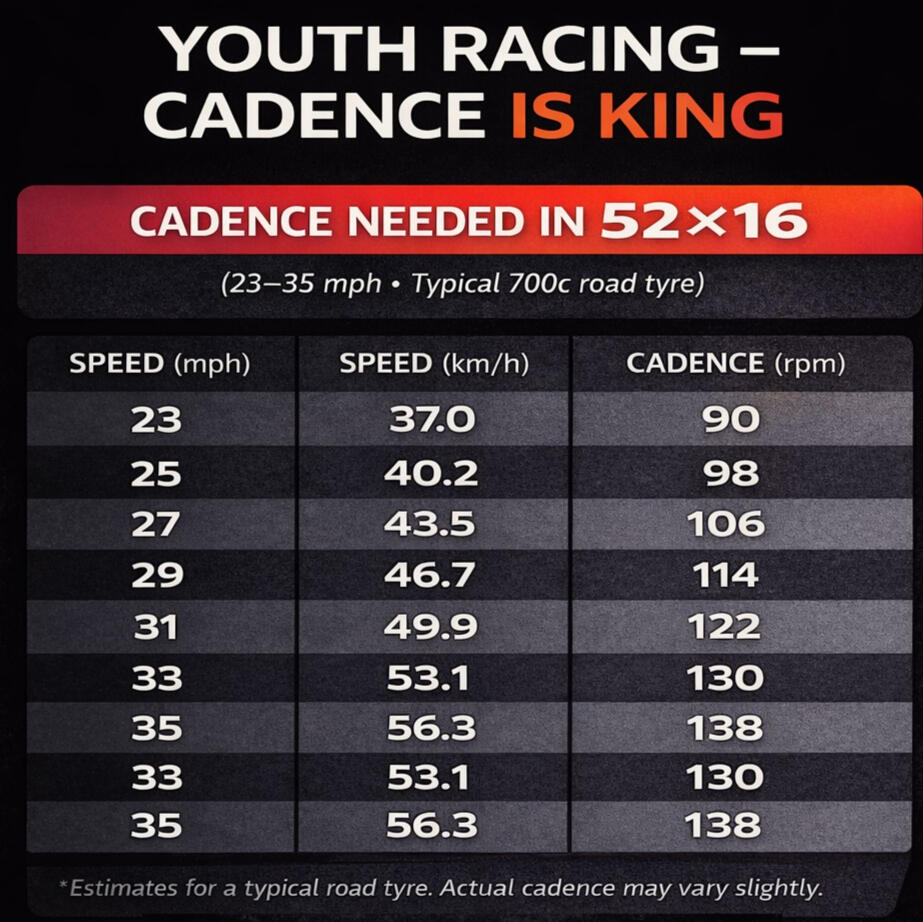
Take a 52×16 gear as an example, using a typical 700c road tyre.At around 23 mph, a rider needs roughly 90 rpm. That’s lively but manageable for most trained riders. At around 27 mph, that rises to roughly 106 rpm, where control starts to matter more. At around 31 mph, it’s about 122 rpm, which is no longer just “pedalling a bit quicker”. It’s a proper skill.By the time you’re looking at around 35 mph, cadence is somewhere near 138 rpm. At that point, any weakness in technique gets exposed quickly. If the rider hasn’t developed the ability to spin smoothly, the body usually starts joining in. Hips bounce, shoulders lift, breathing becomes rushed and the whole thing looks less like cycling and more like someone trying to escape a wasp.That’s why the chart matters. It shows that restricted gearing doesn’t just change what gear a rider uses. It changes what the rider must be able to do physically and technically when the race is fast.Cadence isn't just leg speed
This is where the message needs to be clear, especially for parents and young riders.Telling a rider to “spin faster” isn’t enough. Fast cadence without control isn’t a skill. It’s just panic with pedals.Good cadence should look calm. The legs may be moving quickly, but the body should stay quiet. The hips should remain stable, the shoulders should stay relaxed and the hands shouldn’t be locked onto the bars as if the rider is hanging off a cliff.A simple coaching cue is: fast legs, quiet body.That’s what parents and coaches should look for. Not just the number on the head unit, but the quality of the movement. Can the rider increase cadence without bouncing? Can they stay relaxed when the speed lifts? Can they accelerate without stamping? Can they hold the wheel without turning every surge into a full-body argument?That’s where proper development starts.Parents shouldn’t rush the bigger gears
Parents have a big influence on how young riders understand progress. That’s why this subject matters beyond the rider.It’s easy to think youth gearing is just a temporary rule. Once the rider moves up to juniors, the restrictions are usually removed or become less of a factor, bigger gears arrive, and it’s tempting to think the problem disappears.Except it doesn’t really disappear. It just changes shape.A rider who learns to spin well in the youth categories carries that skill forward. They’ll accelerate more smoothly, respond to attacks better, sit in fast-moving bunches with less panic, and waste less energy when the speed changes. They’ll still be able to use bigger gears when the time comes, but they won’t be dependent on them.That’s the key.If a young rider skips the cadence learning and simply waits for bigger gears, they can become one-dimensional. They may look strong for a while, especially in short efforts or on flatter roads, but they often rely too much on force. They grind, they muscle the bike, and they confuse looking powerful with being efficient.Cycling tends to expose that eventually. It’s a patient sport, but it doesn’t miss much.So parents should praise the skill, not just the result. Praise the smooth pedalling. Praise the relaxed upper body. Praise the rider who stays calm when the bunch speeds up. Praise the rider who learns to accelerate cleanly rather than just smashing the pedals and hoping physics is feeling generous.Bigger gears can come later. The foundation needs to come first.Cadence gives riders more tactical options
This is where cadence becomes bigger than technique. It becomes race intelligence.Bike races are rarely smooth. They surge, stall, stretch, split and restart. A rider hesitates, someone attacks, a corner strings the bunch out, a small gap opens, or the pace lifts into a headwind. That’s racing. It’s not always neat, and youth racing can be especially chaotic because riders are still learning how to read the race as well as ride it.A rider with good cadence has more ways to respond. They can lift speed quickly without immediately changing gear. They can close a small gap before it becomes expensive. They can jump out of a corner without stalling the bike. They can sit in a fast bunch without fighting the pedals every time the pace changes.That matters.A rider who only feels comfortable at one cadence is limited. They might feel brilliant at 85 rpm, but if the race demands 110 rpm, they’re suddenly outside their comfort zone. Equally, a rider who can only spin lightly but has no ability to apply force when needed is also limited.The aim is not to turn every rider into a permanent high-cadence sewing machine. The aim is to build range. A good rider can move between cadences depending on the situation. They can spin fast when the speed lifts, ride more forcefully when the terrain requires it, and choose the right tool at the right moment.That’s not just fitness. That’s education.Why it still matters after youth racing
When riders move into junior racing, the gearing changes, but the value of cadence doesn’t disappear. In fact, riders who have learned to spin well often have a real advantage because they aren’t completely dependent on big gears.This matters all the way through a rider’s career. As riders get older, cadence can become even more important. Bigger gears create more muscular load. That doesn’t make them bad, but it does mean they need to be used intelligently.A rider who only knows how to grind may fatigue more quickly in long races, especially late on when the legs are already carrying damage. They may also place more strain through the knees, hips and lower back, particularly if their strength, mobility or bike position doesn’t support that style of riding.Being able to spin well gives the body another option. It allows a rider to shift some of the demand away from pure muscular force and towards rhythm, aerobic control and efficiency. That can help in fast bunches, rolling terrain, headwinds, long events and those late-race moments when the legs are still attached but have clearly started discussing a transfer request.Cadence is not just a youth skill. It’s a career skill.What riders can do about it
The good news is that cadence can be trained without making it complicated. It doesn’t need endless drills or a full scientific intervention. It just needs regular, focused practice done well.A good starting point is 10 to 15 minutes of cadence work, two or three times per week. That’s enough to make a real difference over time, especially if the rider focuses on control rather than chasing the highest number on the screen.1. Short fast-cadence efforts
Ride 6 × 30 seconds where the aim is to lift cadence while keeping the upper body quiet.These aren’t all-out sprints. They’re skill efforts. If the rider starts bouncing badly, the cadence is too high for their current level of control.2. Controlled spin blocks
Ride 3 × 3 minutes at 100 to 110 rpm during endurance rides.Focus on relaxed breathing, stable hips and light hands. The rider should feel challenged, but not chaotic.3. Acceleration drills
From a steady speed, increase pace by lifting cadence before changing gear.This teaches riders to accelerate smoothly rather than immediately stamping on the pedals. That’s a useful skill in real racing, especially when closing gaps, exiting corners or responding to small changes in speed.4. Watch the quality, not just the number
Parents and coaches can help by watching the quality of movement. Look for quiet shoulders, stable hips, relaxed hands and a smooth pedal stroke.The rider should look fast, not frantic. There’s a difference. One usually develops into speed. The other just looks like a lot of admin.Coach’s note
One thing I notice with young riders is that cadence often gets treated as a small detail, when it’s actually one of the foundations. Everyone can see the rider who wins, attacks or sprints well, but fewer people notice the rider who saves energy every lap because they pedal smoothly, accelerate cleanly and don’t fight the bike every time the pace changes.That’s the sort of skill that compounds. It might not look spectacular at first, but over months and years it changes the rider. They become calmer, smoother and more adaptable. And once they move into junior and senior racing, that matters far more than people realise.The funny thing is, the restricted gear that feels annoying at the time may be one of the best teachers they’ll ever have.Key takeaways
• Youth racing isn’t just about strength. Restricted gears reveal cadence, control and efficiency.• Fast cadence only helps if it’s smooth. The goal is fast legs with a quiet upper body.• Parents should praise skill development, not just results or bigger gears.• Cadence range matters. Good riders can spin quickly, ride forcefully and choose the right cadence for the race situation.• The ability to spin well carries into junior, senior and masters racing because it gives riders more options and reduces unnecessary muscular load.Want help building this properly?
Precision Cycling Coaching works with riders who want to understand what’s really holding them back, not just train harder and hope for the best.For youth riders, that means building the foundations properly: cadence control, race craft, confidence, positioning, pacing and structured training that develops the rider, not just the numbers.For parents, it means having a clearer idea of what to encourage, what to watch for and how to support progress without rushing the process.If you’re a rider or parent and want help building a smarter, more complete cyclist, get in touch.Because the goal isn’t just to ride harder. It’s to build the rider properly.
About the authorAndrew Layhe is a cycling coach with over 40 years of racing experience across road, cyclocross and mountain biking. He is the founder of Precision Cycling Coaching and writes the Coach's Notebook series to help riders train smarter and race better.
Want help making your training feel more consistent?Precision Cycling Coaching helps riders understand their training, fuelling, recovery and performance habits so they can stop guessing and start improving.If you want coaching that looks beyond the numbers, please get in touch.